What is red light therapy and photobiomodulation (PBM)
Red light therapy, often referred to as photobiomodulation (PBM), is a form of light therapy in which specific wavelengths of red and near-infrared light are used to influence biological processes in the body. Unlike heat treatment or cosmetic light, PBM is about how light energy is absorbed by the cells and functions as a biological signal that may support the body’s own regulatory and repair processes. The technology has been used for several decades in research, rehabilitation, and clinical practice, and is now available for both professional use and home use. PBM primarily uses red light in the range of approx. 620–700 nm and near-infrared light in the range of approx. 780–1 060 nm. These wavelengths can penetrate the skin and underlying tissue without damaging cells or tissue when used correctly.
Scientific consensus and clinical guidelines for photobiomodulation (PBM)
In recent years, photobiomodulation has evolved from being a research field with individual studies into an area where systematic reviews, consensus articles, and clinical guidelines are now available. International expert panels have reviewed hundreds of studies to assess both safety and efficacy in the use of red and near-infrared light. These reviews indicate that PBM is a non-ionizing, tissue-gentle technology with documented biological effects when the correct wavelengths, doses, and protocols are used. At the same time, it is emphasized that PBM is not a universal treatment, but a method whose effect depends on precise technical design and correct use.
How red light therapy works in the body – biology and physics
When red or near-infrared light reaches the body, the photons are absorbed by light-sensitive structures in the cells. The best-known mechanism is linked to the mitochondria, the cell’s energy-producing organelles. Here, the enzyme cytochrome c oxidase plays a key role in the electron transport chain and in the production of ATP, which is the cell’s primary energy carrier.
Light absorption may contribute to more efficient electron transport in the mitochondria, better energy availability in the cells, improved utilization of oxygen, and modulation of nitric oxide (NO). Nitric oxide is involved in cell communication and may indirectly support blood circulation. Red light therapy does not supply energy in the same way as heat, but modulates biological signals, which is why the term photobiomodulation is used – light as a biological regulator.
Photobiomodulation as a biophysical signal, not heat or “energy” in a vague sense
Photobiomodulation is often incorrectly described as pure heat treatment. In reality, PBM is about light functioning as a biological signal. When red and near-infrared light are absorbed in tissue, especially in the mitochondria’s cytochrome c oxidase, this may influence the cells’ energy metabolism, redox balance, and signaling pathways. The effect occurs before any significant increase in temperature, which clearly distinguishes PBM from both saunas, IR heat, and other thermal methods. This is also why PBM can be used in a targeted way in clinical settings where heat alone is not desirable.
What is red light therapy used for in practice
Pain and muscle recovery
Red light therapy is often used in connection with muscle tension, stiffness, and recovery after physical exertion. Many people find that light therapy can support the body’s natural repair processes in muscles and connective tissue, especially with regular use over time.
Joints and connective tissue
For strain-related challenges in joints and tendons, PBM is often used as a supplement to other follow-up care. Near-infrared light may penetrate deeper into the tissue and reach structures around joints and connective tissue.
Skin, scars, and aging
Red light is widely used in skincare and aesthetics. Its use is associated with supporting the skin’s own renewal process and influencing collagen and elastin structures. Red light therapy is therefore often included in programs for skin quality and recovery after skin treatments.
Sleep, circadian rhythm, and recovery
Light affects the body’s biological rhythms. Red light therapy can be used in the evening without disrupting melatonin production the way blue light can, and many people use red light to support relaxation and recovery.
Inflammation and stress load
PBM is often used to support the body’s balance during prolonged physical or mental strain. The focus is not on treating disease, but on supporting normal biological processes and well-being.


Red light, near-infrared light, and full spectrum
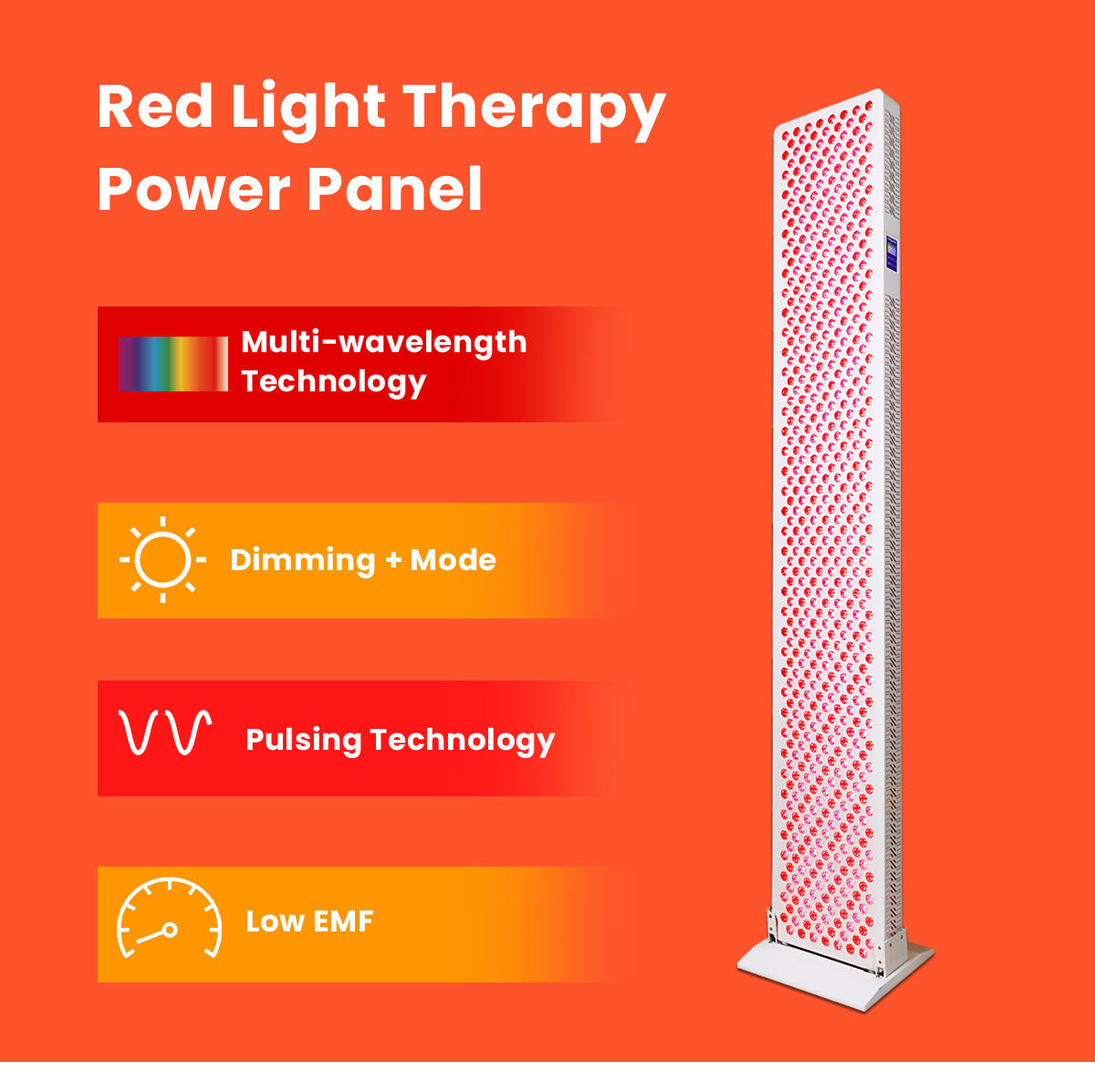
Red light and near-infrared light act at different depths in the tissue. Red light is absorbed more superficially and is often used for the skin and surface tissue, while near-infrared light penetrates deeper and can reach muscles, joints, and connective tissue. Many modern systems combine multiple wavelengths to provide a broader biological response, often referred to as full-spectrum red light therapy.
LED versus laser in red light therapy
Both LED and laser are used in photobiomodulation, but they have different characteristics. Laser provides highly focused light with high precision and is often used in clinical settings. LED-based red light therapy provides more diffuse light that covers larger areas, making the technology well suited for home use and full-body treatment. Effectiveness is not only about power, but also about the right wavelength, dosage, distance, and treatment time.
Dosage, irradiance, and why more light does not always provide a better effect
A key insight from PBM research is the existence of a therapeutic window. Too low a dose produces no biological response, while too high a dose can reduce or negate the effect. Parameters such as power density (mW/cm²), energy dose (J/cm²), treatment time, and distance from the light source are crucial. Professional PBM systems are therefore designed for stable and controllable light delivery, while simpler solutions often result in greater variation in the actual dose. This is an important distinction between medically oriented PBM and general wellness use.
The difference between LED-based PBM and laser-based PBM
Photobiomodulation can be delivered using both laser and LED. Laser provides coherent light with high precision and is often used in medical settings for small, defined areas. LED-based PBM provides non-coherent light, but can cover larger surfaces and is currently the most widely used technology for whole-body and systemic PBM. Modern professional LED systems can deliver high and even irradiance without the safety challenges associated with laser, making them suitable both in clinical settings and for advanced home use.
Home use, clinical use, and regulatory role awareness
It is essential to distinguish between PBM used as a wellness and recovery measure, and PBM used as part of medical or clinical treatment. In Norway and the EU, medical devices are strictly regulated, and the manufacturer’s intended use determines which requirements apply. Serious operators therefore communicate clearly what the equipment is intended for and avoid medical claims where documentation and approval are not in place. For users and clinics, this provides safer choices and more realistic expectations.
Home use versus clinical use
Red light therapy can be used both at home and in professional environments. Home devices are developed for regular use with adapted intensity, while clinical equipment provides higher precision and more adjustment options. The choice depends on needs, experience, and the desired area of use. Many choose home use as a long-term supplement to a holistic lifestyle.


How to choose the right red light therapy
When choosing red light therapy, it is important to look at which wavelengths are used, whether the system combines red and near-infrared light, power per area and not just total wattage, and whether the solution is adapted for spot treatment, larger areas, or whole-body use. Quality, safety, and documentation are decisive factors. The right choice is about biology and physics, not marketing.
Frequently asked questions about red light therapy
How often can red light therapy be used? Many people use red light therapy several times a week, and some daily, depending on intensity and area of use.
Is red light therapy safe? When used correctly and according to the manufacturer’s guidelines, PBM is considered a non-invasive and gentle technology.
How quickly do you notice an effect? The experience varies. Some notice changes quickly, while others experience gradual effects over time.
Can red light therapy be combined with other technologies? Yes, many combine PBM with other forms of light, recovery, movement, and lifestyle measures.
Summary
Red light therapy and photobiomodulation are based on well-known biophysical principles in which light is used as a signal to the cells. The technology combines modern physics with the body’s own biological mechanisms and is now used both in professional settings and at home. For many, PBM is a long-term tool for supporting energy, recovery, and balance in the body.
Conclusion – About Uno Vita’s editorial team
This article has been prepared by Uno Vita’s editorial team with the aim of providing a sober, up-to-date, and professionally grounded review of photobiomodulation and red light therapy. Uno Vita works with documented technologies within light, electro medicine, and biophysical support, and emphasizes quality, transparency, and correct use. The content is intended as general information and cannot replace medical assessment or treatment. Freedom of expression and free access to scientific knowledge are fundamental principles of our work.