Clean drinking water is one of the most important factors for health, well-being, and sustainability. Although Norway has good water resources, the water can be affected by old pipes, chlorination, microplastics, heavy metals, bacteria, and modern environmental pollutants. A modern water purification system can help improve safety, taste, and long-term water quality in the home. This article is an extended professional guide based on the experience of Uno Vita AS as a Norwegian distributor of advanced water purification systems, combined with technological knowledge, practical advice, and documented filtration technologies.
How do modern water purifiers work?
Modern water purifiers often use several filtration technologies at the same time to achieve optimal purification. Mechanical filtration removes particles such as sand, rust, and sediment. Activated carbon filters chlorine, odors, organic compounds, and many environmental contaminants through adsorption. Reverse osmosis forces water through a semipermeable membrane that can reduce dissolved salts, heavy metals, microplastics, and many chemical compounds. UV disinfection uses ultraviolet light to inactivate bacteria, viruses, and microorganisms without the use of chemicals. Combination systems therefore often provide the most complete protection.
5 reasons to invest in a water filter at home
-
Better protection against contaminants
Water filters can reduce chlorine, heavy metals, bacteria, pesticides, microplastics, and other unwanted substances that may occur in both municipal water and well water. -
Improved taste and odor
Activated carbon reduces chlorine taste and organic compounds, resulting in fresher drinking water and better taste in coffee, tea, and cooking. -
Environmental benefits
Filtered tap water reduces the need for bottled water and thereby plastic consumption and transport emissions. -
Financial savings over time
Investing in a water purification system can reduce the cost of bottled water while also protecting household appliances against limescale and particle buildup. -
Tailored solutions for every need
There are systems for kitchen sinks, entire homes, cabins, clinics, and mobile solutions for travel and emergency preparedness.
Examples of modern water purification solutions
Aquaphor kitchen filters and pitcher solutions
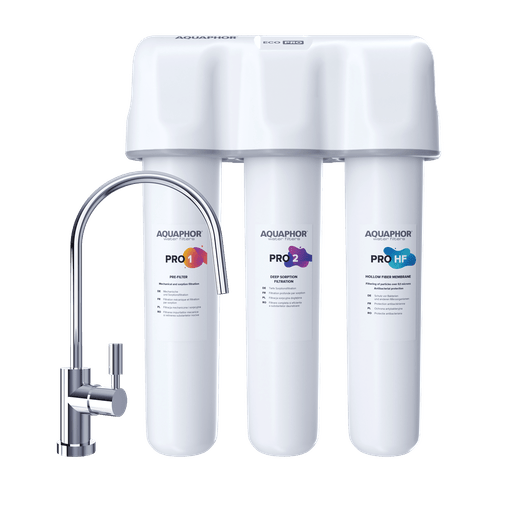


Aquaphor systems are designed for effective filtration of chlorine, heavy metals, and particles through multi-stage carbon and fiber technology. Under-sink models provide continuous access to filtered water, while pitcher systems offer flexible use in smaller households.
Cintropur whole-house systems with UV protection

Whole-house systems combine particle filtration, activated carbon, and UV disinfection to provide complete protection for all water outlets in the home, which is especially useful for well water and cabins.
Reverse osmosis systems for maximum purification


Reverse osmosis provides a very high degree of purification and is often used where the water contains dissolved salts, heavy metals, or specific chemical contaminants. Many systems include post-filtration and remineralization for optimal taste.
How to choose the right water purifier
Start by assessing the water quality through a water analysis. Identify whether the need is primarily for taste, chemical purification, bacterial control, or whole-house protection. Choose technology that matches the need, consider capacity and maintenance intervals, and make sure the system is certified and produced by a reputable supplier. Combination systems often provide the most robust solution.
Conclusion
A modern water purification system is a long-term investment in health, comfort, and sustainability. Even in countries with generally good water quality, local conditions, pipe networks, well water, and environmental pollutants can affect the water. By choosing the right water filter, you get safer drinking water, better taste, and increased control over water quality in the home.